Claudia
-
Property Type
LSE Gold Silver Project
Size
69,388 ha
Status
Optioned to Cerro Vanguardia SA Gold-Silver Mine
Exploration Stage
Drilling, geological mapping, geophysical surveys
Location
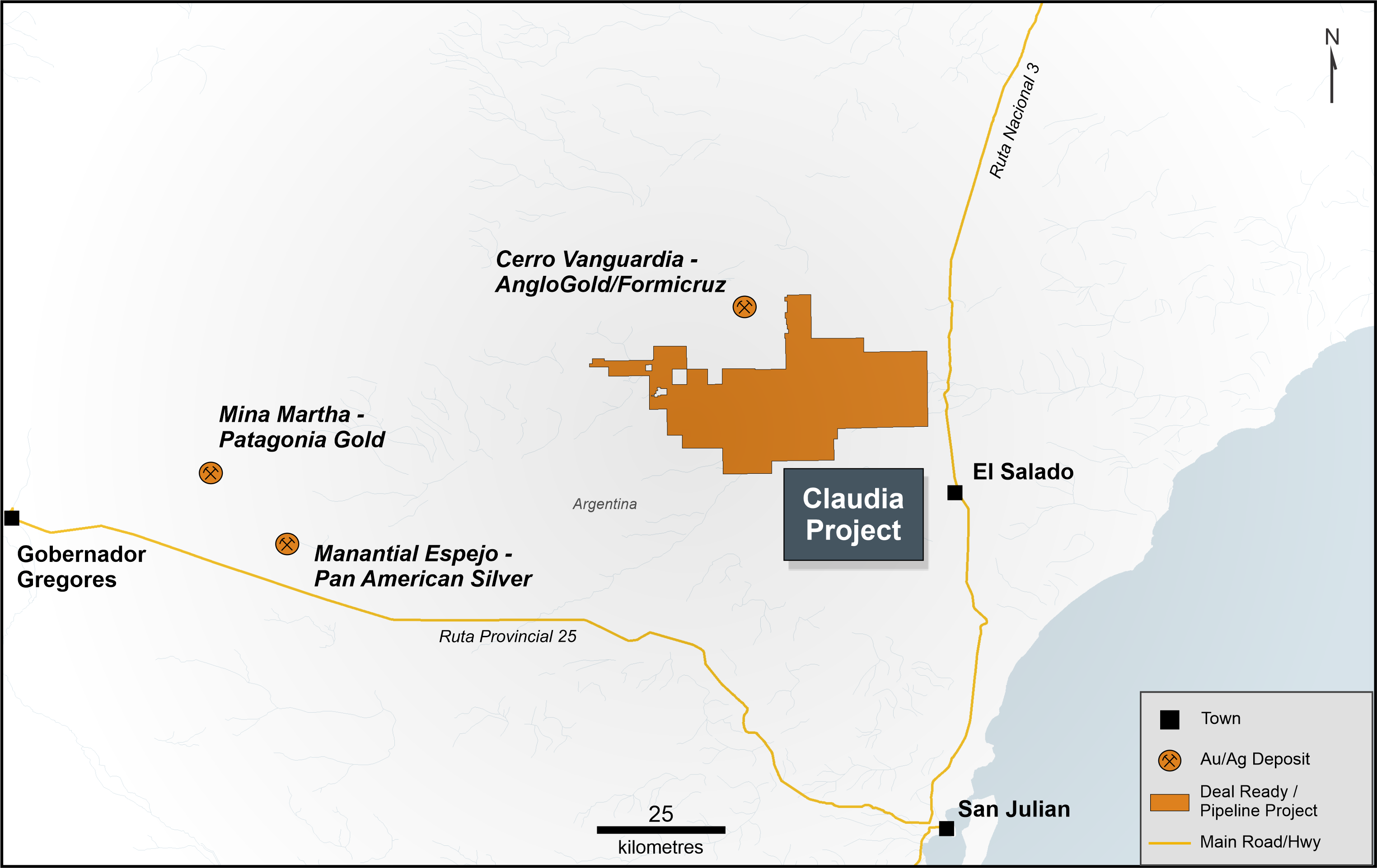
- Located in the Deseado Massif, in the Santa Cruz Province, Argentina
- Adjacent on the southern border of the producing Cerro Vanguardia gold-silver mine (Anglogold Ashanti/ Fomicruz S.E.)
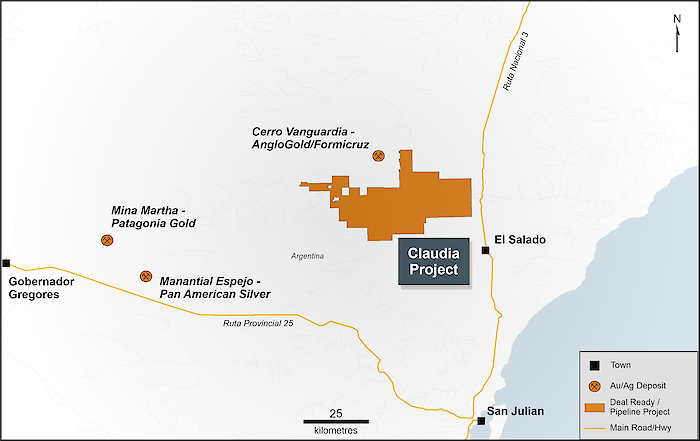
On May 23, 2023, Mirasol announced the signing of an option agreement with Cerro Vanguardia SA Gold-Silver Mine (“CVSA”) owned by AngloGold Ashanti (92.5%) and FOMICRUZ S.E. (7.5%) for the exploration of Mirasol`s Claudia Gold-Silver Project (“Claudia”), located in the Deseado Massif of Argentina’s Santa Cruz province, directly adjacent to the southern border of the producing CVSA Gold-Silver Mine.
Terms of the Claudia Option Agreement:
a) Within the first two years of the Agreement CVSA may complete such mapping and sampling, trenching and geophysics as required in its absolute discretion to develop drill targets, and fulfill a minimum drilling commitment of 2,500m of diamond drilling; and then CVSA will have the option, subject to the terms of the agreement, to:
1) Within three years, complete not less than an aggregate of 6,000m of diamond drilling;
2) Within four years, complete not less than an aggregate of 12,500m of diamond drilling;
b) Upon completion of the above commitments, CVSA shall have the right to exercise the Option under the Agreement and, subject to the terms of the Royalty Agreement, CVSA shall grant Mirasol a 2% Net Smelter Royalty on future production from the Claudia Project.History at Mirasol`s Claudia Property
The Claudia Project was originally staked in 2004 as part of Mirasol’s Santa Cruz exploration program. Mirasol, in conjunction with various JV partners, has completed over 19,000 m of combined RC and DDH drilling, more than 4,000 line-km of ground magnetometry, 249-line km (43 km2) of gradient array IP geophysics covering six separate blocks, almost 100-line km`s electrical IP- Pole-di-Pole geophysical lines, collected over 3,500 rock chip samples, 4,500 rock trench channel samples from 200 trenches, close to 1000 MMI geochemical soil samples and 1,500 km2 in detailed geological mapping.Between 2006 and 2010 two phases of drilling were completed with a JV partner, including 3,794m of drilling in 26 holes and 3,168m of RC drilling in 25 holes. Drilling results from these campaigns included multiple intercepts with greater than 100 g/t Ag, including five intercepts from 118 g/t Ag to 217 g/t Ag and up to 1.3 g/t Au.
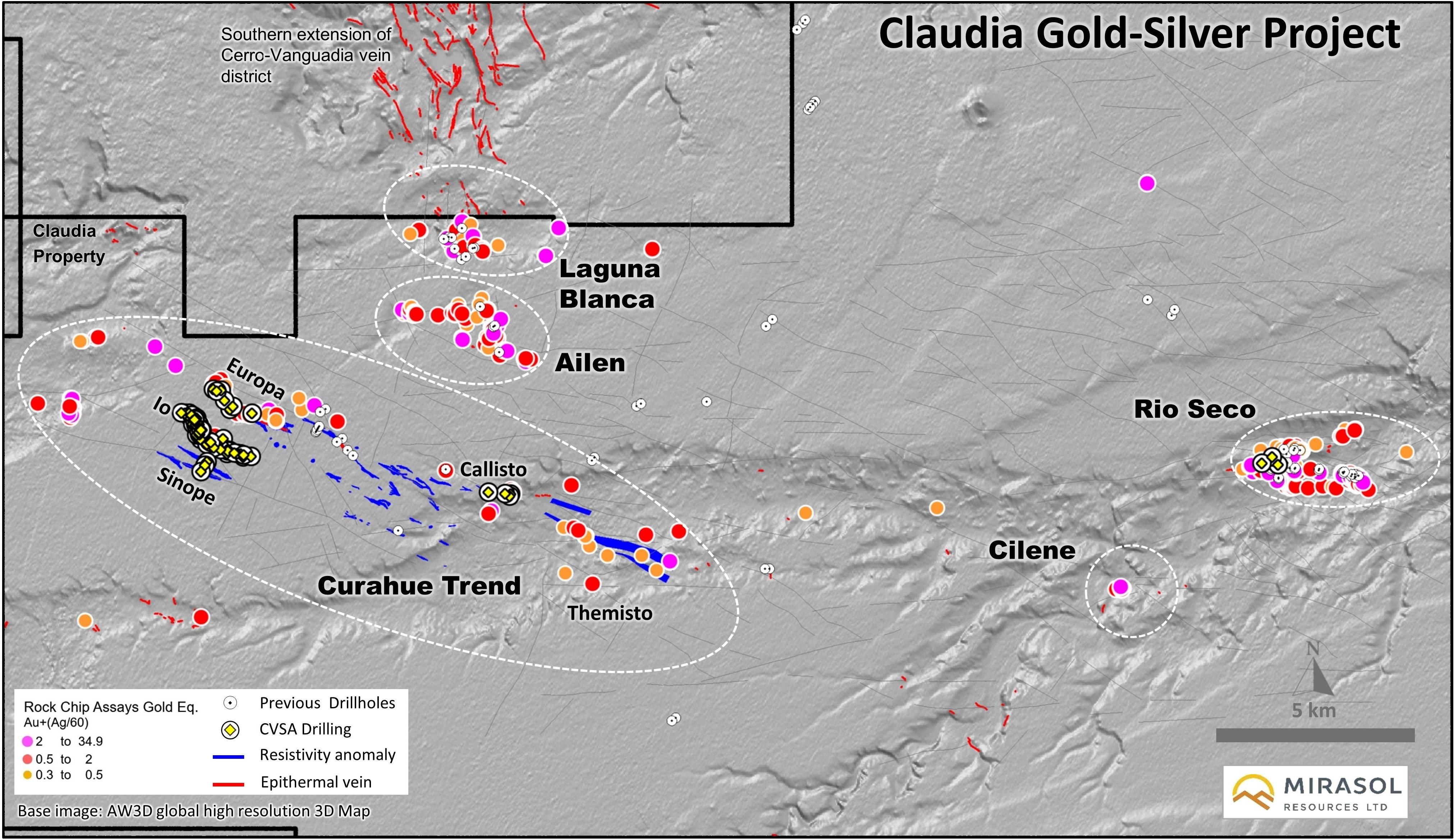
During 2012, Mirasol`s inhouse exploration team expanded and defined the impressive 15 km long Curahue vein trend, which is largely concealed by shallow gravel cover (<5m) and is seen to host six large individual vein trends, namely the Europa, IO, Ganymede, Callisto, Themisto and Sinope segments. Large extensions of these trends have been traced under cover by electrical IP (Gradient Array) geophysical campaigns.
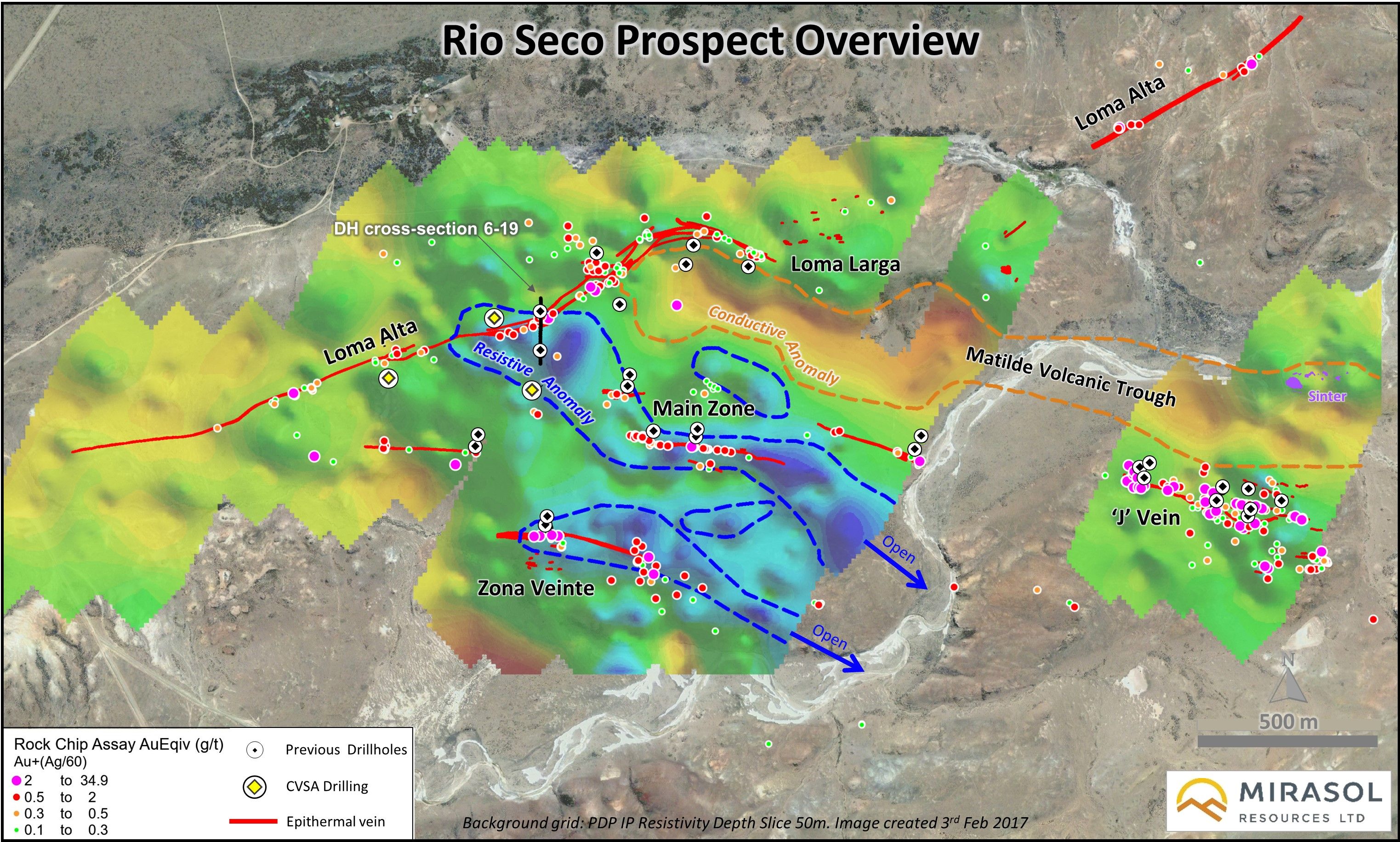
At the Rio Seco prospect, located on the easternmost part of Claudia, Mirasol’s early prospecting discovered the first outcropping veins at Claudia where select surface samples returned up to 20.1 g/t Au and 1,175 g/t Ag from the “J Vein”. Saw-cut channel and trench intersections returned 0.7m at 13.9 g/t Au and 229 g/t Ag and 10.5m of 1.9 g/t Au and 22 g/t Ag from mineralized zones along the expansive Rio Seco vein field (news release June 14, 2012).
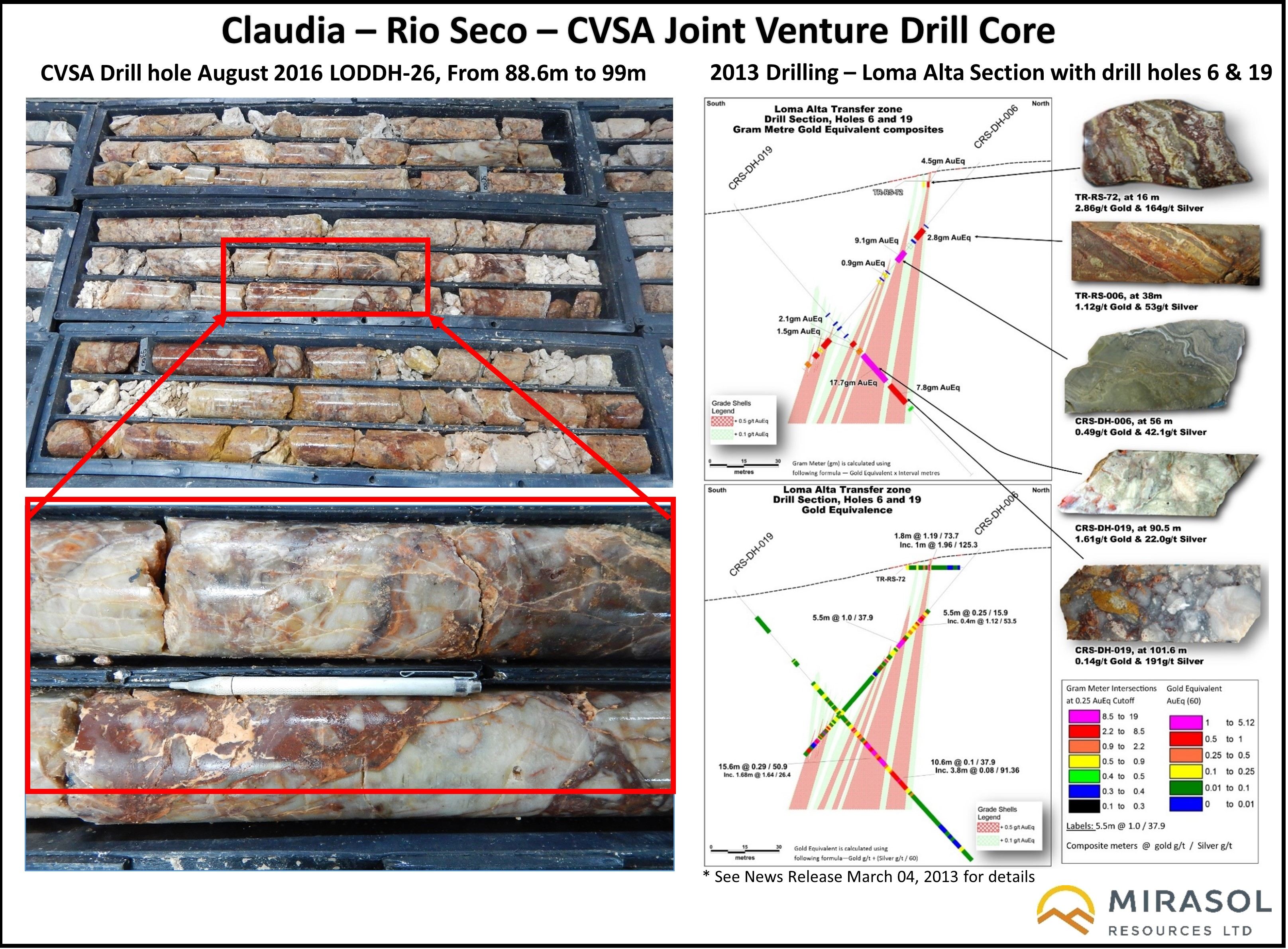
During Q2 2012, Mirasol drilled a total of 2,599m in 25-holes. The best results included individual assays of up to 0.83m at 6.59 g/t Au and 139.3 g/t Ag and broad intersections of anomalous Au and Ag up to 15.3m of 0.29 g/t Au and 50.9 g/t Ag (news release March 4, 2013).
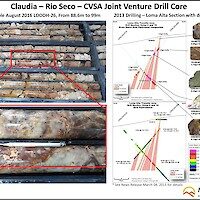
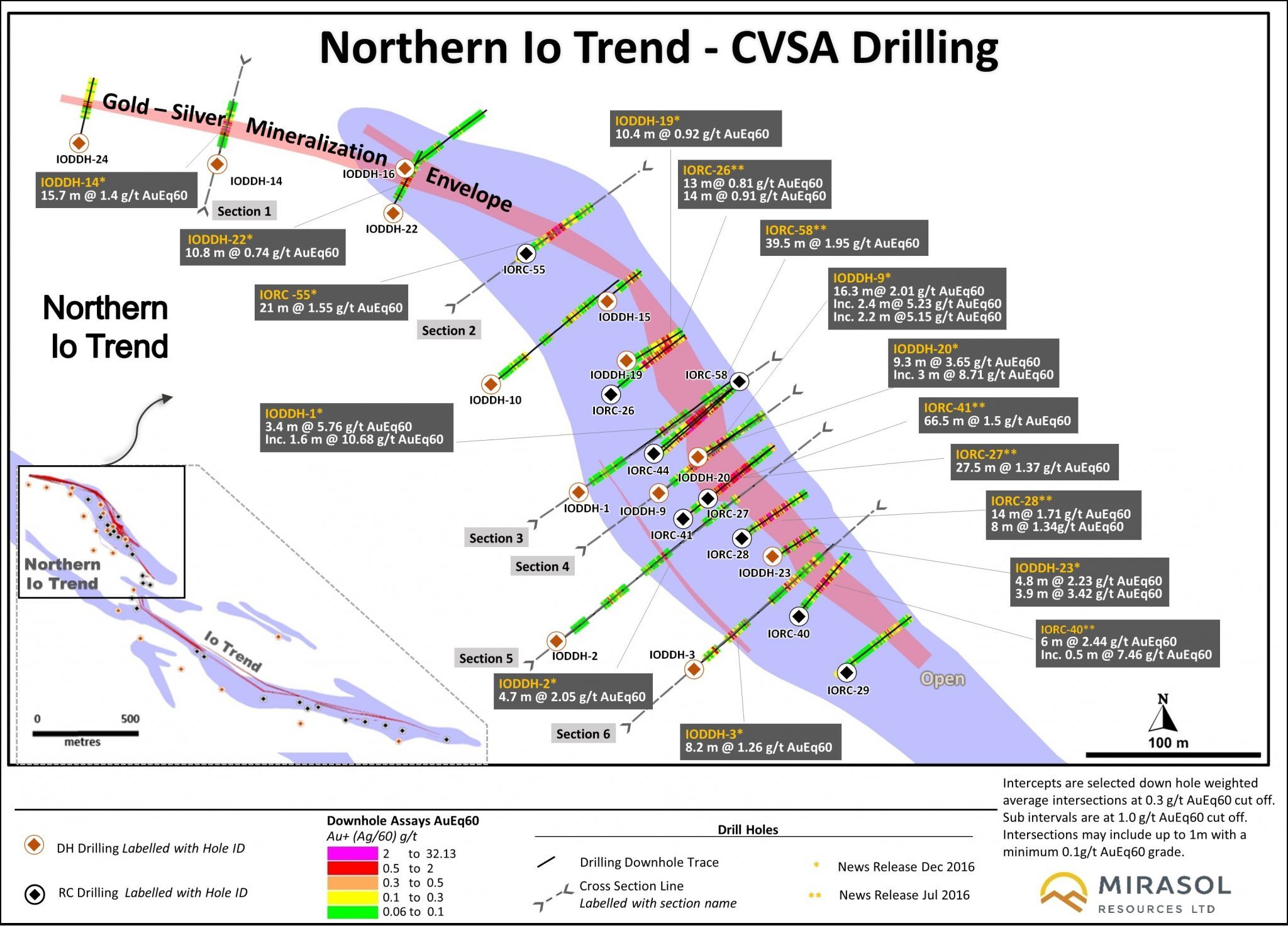
During 2016/17, under a previous JV with CVSA, a combined 7,525m of RC and DDH drilling was completed at Claudia. The majority of the drilling was focused along a 2.2-km section of the “IO vein”, one of the six prospects identified to-date along the 15 km long Curahue trend (news release December 16, 2016 and February 17, 2017).
A major “milestone” of the CVSA drilling at the “IO” vein was the discovery of a 600m long, open-ended mineralized body hosting silver/gold mineralization which starts a few meters below surface and has been drill tested to a vertical depth of 135m. This strongly mineralized trend requires follow-up work both downdip and along the strike of the structure. Highlight results included:
High-grade vein: 0.6m at 11.72 g/t Au and 1,224 g/t Ag
Vein and veinlet composite: 9.3m at 1.40 g/t Au and 134.6 g/t AgFrom October 2017 through March 2019, Mirasol with a JV partner drilled 2,529m in 12 holes at Claudia. Drilling completed to July 2018 focused mostly at the Curahue prospect, with 10 DDH holes totaling 2,270m completed, to test targets on the Europa, IO, Themisto and Callisto segments, along the extension of the Curahue trend.
Drill results from the Curahue prospect, Europa and IO vein trends include 0.6m at 0.08 g/t Au and 610.0 g/t Ag, 0.55m at 1.15 g/t Au and 22.9 g/t Ag; and 0.9m at 1.95 g/t Au and 5.7 g/t Ag from the Cilene prospect (news release September 17, 2018).
Following termination of that JV, Mirasol completed additional surface exploration work resulting in the definition of new drill targets that remain to be tested. A total of 249 new rock chip samples were collected from the Curahue trend, with results up to 7.99 g/t Au and 69 g/t Ag. In addition, two new IP geophysical surveys, focused on the Curahue and Themisto prospects, were completed extending existing survey coverage at Claudia (news release May 8, 2019).
Highlights from the Claudia OceanaGold Joint Venture exploration
During the OceanaGold agreement, 12 DDH holes totaling 2,529 m have been drilled, testing targets at the Curahue and Cilene prospects. Assays from the Curahue prospect, Europa and Io trends include 0.6 m at 0.08 g/t Au and 610.0 g/t Ag, and 0.55 m at 1.15 g/t Au and 22.9 g/t Ag; and from the Cilene prospect 0.9 m at 1.95 g/t Au and 5.7 g/t Ag.
Drilling at the Europa target at Curahue, intersected zones of epithermal veins, veinlets and silica-sulfide structures up to 13.7 m wide in three of the holes drilled. The veins and silica-sulfide structures are hosted in what is interpreted to be the upper part of the Jurassic-age Chon Aike volcanic sequence. At the nearby multi million-ounce Cerro Vanguardia mine, the distinctive Granosa Ignimbrite unit of the Chon Aike volcanics is the primary host to the majority of ore grade veining. The Granosa unit is interpreted by Mirasol geologists to occur stratigraphically below the current depth of drilling at Europa, Io and Themisto. The intersection of these vein zones with the Granosa unit may represent a target for further drilling in the Curahue prospect.
Five DDH holes were drilled into the 2.9 km long Europa trend to test covered geophysical targets beneath post mineral unconsolidated gravel and a large alluvial terrace composed of cobble to boulder-size clasts of epithermal vein material. Previous rock chip sampling of the epithermal blocks in the alluvial terrace returned assays of up to 1.66 g/t Au and 2,130 g/t Ag. Assay results from the Europa drilling returned anomalous Au+Ag with strong epithermal pathfinder elements (As, Sb). Assays include a best downhole intersection of 0.6 m at 0.08 g/t Au and 610.0 g/t Ag from a silica-sulfide structure.
A 360 m DDH core hole was drilled at the “Io” trend to test at depth beneath the previously reported Au+Ag drill intersections where drilling intersected a 40 m wide zone of veining and veinlets at a depth of 240 m which is interpreted to be the down-dip extension of the “Io” vein zone and returned a best intersection of 0.55 m at 1.15 g/t Au and 22.9 g/t Ag.
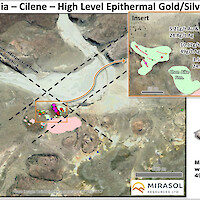
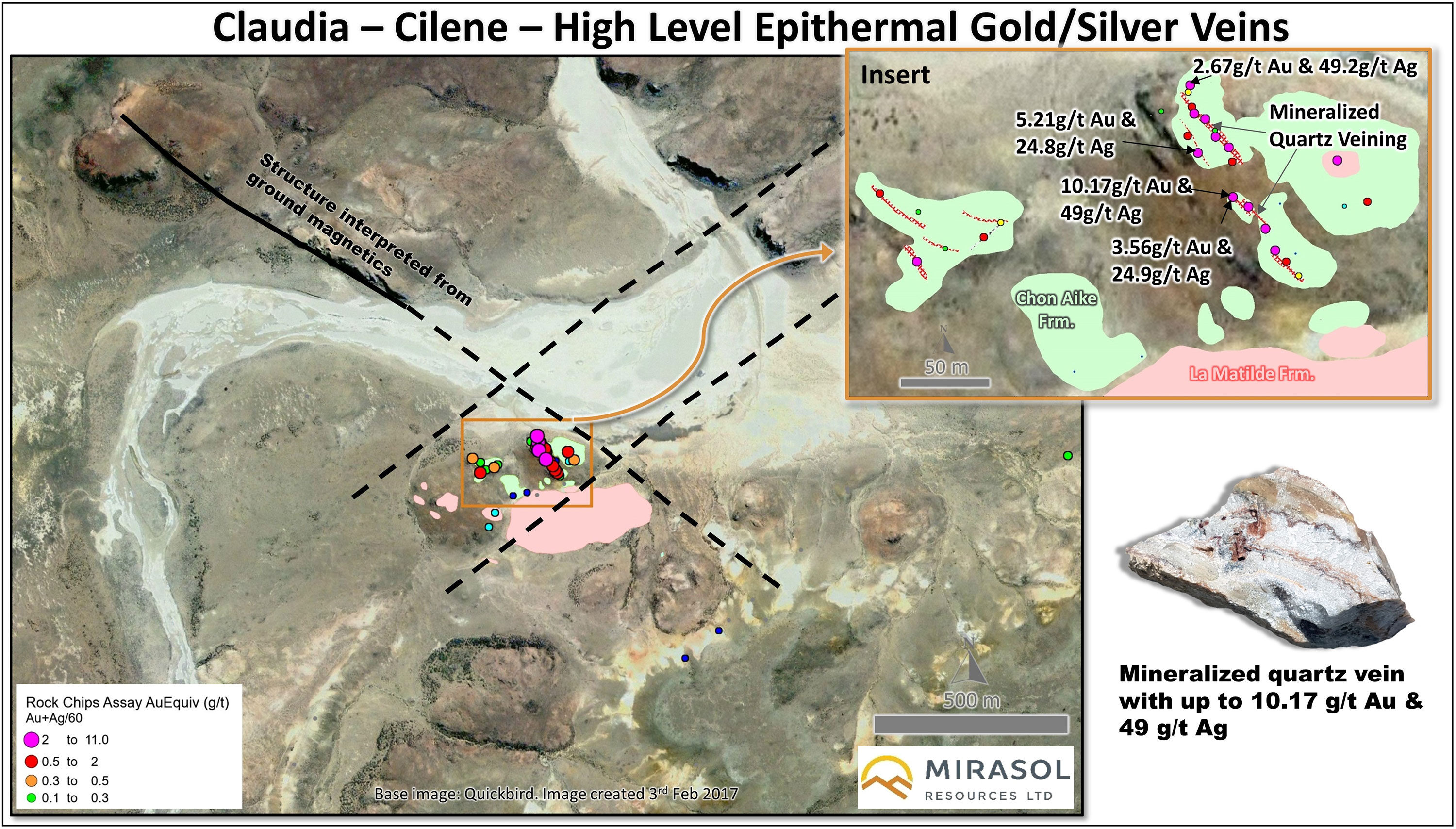
At the Cilene prospect, two DDH holes on section totalling 259 m, were drilled to test the 10 to 20 cm wide outcropping veins with select rock chip assays ranging up to 10.17 g/t Au and 49.0 g/t Ag, to a maximum depth of 75 m below surface. The best drill intersection in the deepest hole (CIL-DDH-002) was 0.9 m at 1.95 g/t Au and 5.7 g/t Ag.
More Recent Geological Mapping, Sampling and 3D Geophysical Models
Analysis of Mirasol´s in-house 3D geophysical block models has outlined a district-scale horst and graben structural setting, identifying large NW-oriented normal faults that appear to have acted as hydrothermal fluid conduits and may potentially also influence mineralized vein development.
At the Rio Seco prospect the magnetic and IP models when combined with geology and previous drill results, outline a series of priority targets where the prospective Granosa host rock is known to be present; coincident with evidence of undrilled epithermal veining and/or geophysical anomalies and large-scale faults.
At the “Io” and Europa trends, integrated analysis of the magnetic model and existing geological and geochemical data sets have identified a large graben-bounding normal fault to the north of the Europa trend. There has been no previous drill testing of this fault zone; however existing drill and rock chip geochemistry suggest mineralization vectors towards the fault trace. A gradient array geophysical survey which covers part of the fault zone has outlined a series of resistivity and chargeability anomalies within the fault trace, that represent untested quality drill targets.
Recent surface sampling at the Europa trend has returned Au+Ag anomalous rock chip assays including a peak assay of 7.26 g/t Au and 124.0 g/t Ag (with the previous best rock assay from the Europa trend of 4.09 g/t Au and 127.0 g/t Ag) from epithermal vein blocks up to 0.6 m in size, suggesting the blocks are sourced from a larger covered vein. These results indicate a potential extension of the Europa trend to the SE into an area that has not been previously mapped nor drill tested.
Finally, prospecting to the north of the Themisto trend has identified narrow (cm wide) epithermal veinlet trends in outcrop that to date have been traced intermittently for a 250 m strike length. Select rock chip sampling of the veinlets has returned assays of up to 2.49 g/t Au and 8.3 g/t Ag. Outcrop is sparse, and existing electrical geophysics surveys do not extend into this area to guide exploration. However, the Mirasol ground magnetics show a large-scale NW-SE oriented fault hosting the veining, suggesting the potential for larger-scale vein development within the fault in this new portion of the Themisto trend.
-